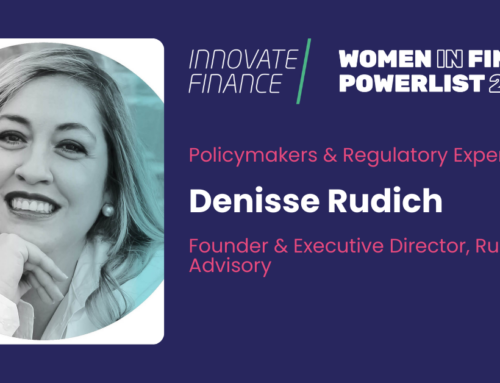



Regulatory Intelligence speaks to important figures in the compliance and financial arena to hear their thoughts and discuss wider issues related to their fields. Today we talk to Denisse Rudich, founder and chief executive of Rudich Advisory and CCO of ElementaryB.
Denisse is a champion of financial crime prevention initiatives with nearly 20 years of experience in delivering financial crime prevention strategic solutions across banking and the public sectors. She works at the intersection of governance, financial crime, technology and conflict finance.
Denisse is the director of the G7 & G20 Research Groups (London), founder of Derumari and an associate fellow at the Royal United Services Institute (RUSI).
What is a typical workday like for you?
No day is ever really the same as my work depends on the needs of my clients, who can include international organisations, start-ups, regulators, civil society, private banks, crypto exchanges, etc., all looking to optimise how they fight financial crime. But I find that getting in a morning walk with my dog and having a delicious cup of coffee at the ready is the best way of setting me up for the day.
My work ranges between drafting technical documents (some of which require intense research, analysis and concentration), stakeholder engagement and advocacy (which requires an understanding of different objectives and interests and trying to navigate the best outcome for all) and staying on top of the latest news and trends in the field of financial crime prevention, which is where scrolling through LinkedIn feels not only like a treat but also a way of staying in touch with peers that has become essential.
Which part of your job gives you the most satisfaction?
I enjoy knowledge-sharing and capacity-building with national authorities, front-office staff, journalists and members of civil society, particularly when they have that “Aha!” moment as to why this industry exists or what tweaks can be made, either by introducing or updating policy, laws, regulations or technology, to make it harder for criminals to access the financial system or easier to follow the money and seize assets.
I also enjoy building collaborative frameworks, putting people and organisations together to effect change and bring together different pieces of the puzzle.
I also enjoy the sanctions space and would love to work a bit more on economic statecraft as I studied intelligence and military history so I find this whole area fascinating.
What part of your job gives you the most frustration?
I would say watching the news and seeing people’s lives being harmed due to systemic corruption that allows crime to thrive and leaves little recourse for people in certain countries due to the theft of state assets. There are so many people doing such amazing work in this field, but greed and power are a toxic combination.
I also get incredibly frustrated when it appears as if progress disappears into thin air due to re-structures or changes in leadership, or seeing a lack of change in organisations where the same mistakes are repeated due to what can feel like apathy but is often just the challenge in building consensus against so many competing objectives.
What are the most significant forthcoming developments in financial services that you are concerned about or you think the profession/industry should be concerned with?
There are many regulatory developments happening in 2024. Sanctions are top-of-mind as innovative sanctions designations continue to emerge, for example, the G7 diamonds ban.
Financial crime professionals should also take part in consultations regarding artificial intelligence (AI) and understand how proposed regulations, standards and regulations could affect their ability to incorporate AI-based solutions.
New supervisory bodies are also being launched in Canada, the EU and Germany, and the implementation of the EU’s anti-money laundering (AML) package should be of concern to firms which have operations in Europe, with transition plans already in place.
Updates to transfer of funds regulations, ISO200022 creating a standardised approach to payments and the proliferation of open banking and real-time payment rails will create both opportunities and challenges for firms.
Meanwhile, crypto is not going anywhere, so firms looking to work with clients who deal in crypto or with exchanges should stay on top of new legislation around the world, including proposed frameworks being introduced in stablecoins.
Which international regulatory development causes you the most concern?
As someone who works at the intersection of global governance, financial crime and technology, I am concerned about the combination of greater reliance on financial services firms to use their AML/CFT/CPF programmes to identify financial flows linked to national security threats against a background of 40+ national elections in 2024, heightened instability worldwide, emerging conflict zones, digital warfare and rhetoric on the use of nuclear weapons.
I am also concerned about the need to continue to address financial inclusion to bank the unbanked and the recent overtures made to politically exposed persons (PEPs) following the UK’s NatWest scandal that launched a regulatory review of domestic PEPs.
Has the increased focus on ESG changed the way you work? And if so, how?
There is more focus on building ESG-by-design into the work that I do. This can range from trying to minimise waste (in Canada, we were taught at an early age to “Reduce! Reuse! Recycle!”) and energy consumption, staying home while sick, adopting equitable hiring principles and gender diversity, supporting small and medium-sized businesses and promoting innovation however and wherever possible.
There is, however, much more that could be done, not only in terms of ways of working but also how services are offered to clients.
Has the pandemic changed the field of compliance and risk? How has it affected your work?
The impact on the field has been substantial. The mass move to digitalisation, the proliferation of data online, and a culture of now have created many opportunities for criminals to exploit and drive forward computer-enabled crime. We have seen what has been labelled as a fraud pandemic, with fraud now a national security concern, and the emergence of crime-as-a-service as a new industry enabled by AI, synthetic identities and deep fakes.
The stress on people working in large organisations whose job it is to protect consumers is, I would say, at record levels as they scramble to refine and retune controls to changing environments.
In terms of my work, the pandemic made regtech more mainstream, as technology is needed to fight technology. On a day-to-day level, I have had a small business and worked remotely for quite some time, so the main change that I have seen is greater tolerance and acceptance of different ways of working, with people being happier to meet online as opposed to having to trek halfway across town, or the world, for a meeting.
How are things changing in your world with the proliferation of regtech companies and products?
I remember joining the Regtech Council in the UK in 2017, where I had the opportunity to meet some of the UK’s (and possibly the world’s) leading minds on technology, regulation and finance — PJ Di Giammarino, Samantha Sheen, Jo Ann Jenkins, Adriana Ennab, to name a few. Back then, regtech was a new concept but I have enjoyed seeing the growth of the industry and some of the extraordinary solutions that have emerged.
The challenge that remains for new regtechs is having a safe space and the funding to be able to build, co-create, test and scale new solutions while ensuring the survival of the company. This is where initiatives such as the UK Financial Conduct Authority’s (FCA) Digital Sandbox and the Monetary Authority of Singapore’s (MAS) RegTech Technology Grant, as well as the Alliance for Innovative Regulation in the UK, have a huge potential to allow for new regtechs to flourish and have an impact.
I am in the process of creating a regtech with some wonderful humans using large language models to build the capacity of journalists, national authorities and banks in emerging markets to understand how money moves around the world using financial products to tackle transnational corruption and economic and financial crime.
What are your thoughts on crypto — do we need more regulation in this area?
I welcome the positive steps taken by countries to regulate any novel financial product that is offered to consumers, especially when they can lose their life savings. What I would love to see in addition to regulation being rolled out around the world is more harmonisation of regulation as there are so many loopholes and variances in interpretation and varying requirements that it is becoming difficult and expensive for exchanges that operate internationally to protect their customers.
More dialogue with the industry is also needed to understand emerging products in the crypto sector, how they work, the flow of funds, risks and what mitigants can be applied whether by using smart contracts or exploring novel ways and technology to minimise harm.
What pearl of wisdom would you give to a budding compliance officer?
Please just ask. The world of regulatory compliance is open to interpretation so no question should ever be frowned upon. Also, look to upskill on how data and different types of technology (AI, blockchain, cloud computing, natural language processing, real-time analysis, etc.) can be used to fight financial crime, as I do believe that the compliance team of the future will be made up of half-man and half-robot.
What has been your greatest professional achievement?
That I can talk about? In terms of impact, contriving to develop a strategy as part of my work with the Global Coalition to Fight Financial Crime to elevate environmental crimes as an international policy issue is up there, especially as (I hope) this will contribute to the future of the world in which our children will live.
This included mapping different types of environmental crimes to environmental, social and governance (ESG) concerns, securing meetings with the French 2019 G7 Presidency to advocate for the inclusion of environmental crimes into the agenda which focused on equality and designing an event held at the World Economic Forum which focused on environmental and wildlife crimes.
It was only years later that I learnt that the topic of environmental crimes was placed into the interior ministers track of the G7 Biarritz Summit and an outcome document was issued with various commitments made to tackle environmental crimes, with the focus remaining on environmental crimes to this day.
What do you do to relax?
Walking the dog, going to the gym, and hanging out and laughing with my family and friends.
Can you recommend a restaurant to us?
My absolute favourite Chinese restaurant is Tai Tung in Croydon. It serves delicious Dim Sum on the weekends and it reminds me of my university days living in Chinatown in downtown Toronto.
By Anne Kilminster, Regulatory Intelligence.
Orginally published on Thomson Reuters on 5 January 2024.